
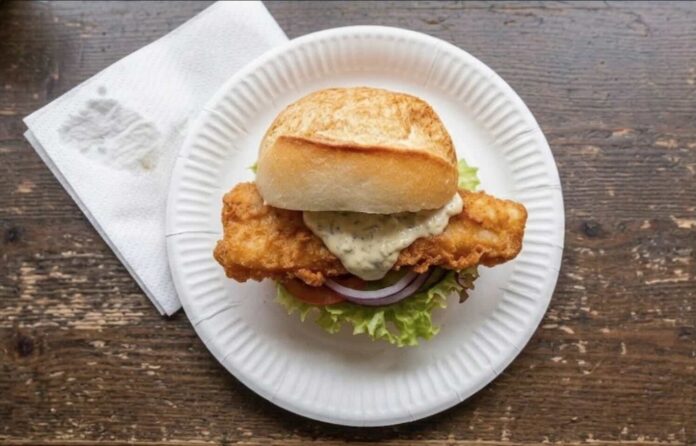
I didn’t grow up eating Fischbrötchen. I grew up Mediterranean, where fish meant whole sea bream on the grill, fried calamari still popping with oil, sardines over charcoal on the beach. Fish on bread with remoulade? That concept didn’t exist in my world. Then I moved to Hamburg, and within about two weeks somebody handed me a Bismarck herring in a crusty Brötchen at the Fischmarkt at 7 a.m. on a Sunday. I didn’t even like herring at the time. Didn’t matter. Something about the cold air off the Elbe, the chaos of the market, eating a whole cured fish on bread before most people had brushed their teeth. It just worked.
Since then I’ve eaten an embarrassing number of Fischbrötchen across this city, in the harbour, in random residential neighbourhoods, and at those battered little stands on Autobahn rest stops between Hamburg and Flensburg where you pull over because the sign says “Fischbrötchen” and you can’t not stop. That’s what living in the north does to you.
But this article isn’t really a ranking. I tried to write one, and it felt wrong. Because the best Fischbrötchen in Hamburg isn’t about which stand has the freshest Matjes or the crunchiest Brötchen. It’s about what happens to you while you’re eating it.
The Fischbrötchen is Hamburg’s espresso
In Italy, you stop at a bar, you stand at the counter, you drink your caffè and eat your cornetto. It takes four minutes. Nobody sits down. Nobody makes a thing of it. It’s just what you do, every morning, and it connects you to the rhythm of the city. Every Italian knows this. It’s not about the coffee being exceptional. It’s about the ritual. The pause. The fact that everyone around you is doing the exact same thing.
Hamburg has that, and it’s the Fischbrötchen.
You’re walking along the Elbe on a Saturday morning, it’s grey and a bit cold (it’s always a bit cold), and you stop at a stand. You order a Matjes or a Backfisch. You eat it standing up, looking at the water, maybe with a paper napkin stuffed in your coat pocket. The wind is doing something unpleasant to your hair. You don’t care. For three minutes you’re not a tourist, not an expat, not someone who moved here from somewhere warmer and still can’t believe how dark November gets. You’re just a person eating fish by the harbour. You belong.
That’s the Fischbrötchen. That’s what it does. It makes you one with this city in a way that no restaurant meal or fancy dinner ever will.
What actually makes a good one?
A Fischbrötchen is simple: fish, bread, maybe some onion, remoulade, lettuce if you’re lucky. That’s it. So everything has to be right.
The bread matters more than people think. If the Brötchen is stale or too soft, it’s over. You want that slight crunch on the outside with a bit of give inside (classic Nordbrötchen, not some pre-sliced supermarket roll). The fish should taste like fish, not like fryer oil from last Tuesday. And the ratio has to work. Too much bread and you’re eating a roll with a hint of fish. Too little and everything slides out onto your jacket. I’ve ruined at least one coat this way.
Remoulade is the wild card. Some places make their own, and you can tell: it’s tangy, a little sweet, with actual herbs in it. Others use what I’m pretty sure is mayo from a bucket with some relish stirred in. Both can work, honestly, but the homemade stuff elevates everything.
It’s not about the “best” stand
Here’s the thing I’ve learned after years of eating these. The context matters more than the fish. A perfect Fischbrötchen from a famous stand, eaten while you’re stressed and rushing to catch the S-Bahn, is just food. A mediocre one from a random Autobahn rest stop near Neumünster, eaten leaning against your car while the rain starts and you’re halfway to the coast for no particular reason, is a memory.
The Italians understand this about their espresso. The French understand this about their baguette. It’s not about finding the objectively best one. It’s about letting the small, cheap, everyday version of it become part of how you live.
I stop for Fischbrötchen the way I used to stop for espresso back home. Without thinking. Because the stand is there, and I’m hungry, and it’s what you do in this city.
Places I like (if you want actual names)
That said, you still need to know where to go. Not because one place will change your life, but because a bad Fischbrötchen (soggy bread, old fish, sad remoulade) can genuinely ruin the experience. So here are the spots I keep coming back to.
Brücke 10 at the Landungsbrücken is the obvious one. Ten different Fischbrötchen, from Kräutermatjes to Räucherrollmops. The Matjes is my default: soft herring, fresh onions, crunchy Brötchen, every time. The Krabbenbrötchen is around €15 right now, which hurts, but Nordseekrabben are expensive everywhere. If that price makes you flinch, Fischpfanne (also at the Landungsbrücken) does one for €7.50. No indoor seating at either. You eat outside, by the water, which is the whole point. They also run a container stand called “Borni” at Bornsteinplatz near the Alter Elbtunnel.
Atlantik Fisch on Große Elbstraße 139 is where the locals go. Part fishmonger, part bistro, right in the wholesale fish district in Altona. They speak nine languages behind the counter. The Backfisch with homemade remoulade is great, and you eat standing at high tables with a view of the Elbe. The daily lunch special is about €15 for a proper fish plate, which is fair for what you get.
Kleine Haie Große Fische on Querstraße 4 in St. Pauli is the cosiest option. Everything made fresh to order, including warm toppings like grilled salmon patties. They give you a free Mexicaner (spicy tomato shot) with your Fischbrötchen, which tells you everything about the vibe. Popular as a late-night Reeperbahn pit stop. More generous portions and lower prices than the harbour stands.
Fischbeisl on Große Elbstraße 131 is run by an Austrian, which sounds like a joke, but the Fischfrikadellen are excellent on a good day. White tiles, open kitchen, picnic tables outside. It can be inconsistent, but when it’s on, it feels more real than anywhere near the tourist strip.
Fischhaus Loop on Straßburger Straße 15 in Dulsberg is nowhere near the harbour, which is why I love it. A fishmonger in a residential neighbourhood, doing Matjes or Bismarck Fischbrötchen for about €3. Three euros. Daily lunch menu under €8. The regulars here are the kind of people who’d notice immediately if the fish wasn’t fresh. It’s been running for 30 years. No harbour view. No Instagram. Just fish.
The spots I’d skip
Most of the Fischbrötchen stands inside Hamburg Hauptbahnhof are not worth your time. The bread is usually soft and sad, the fish tastes like it’s been under a heat lamp since the morning S-Bahn rush, and you’re paying tourist-adjacent prices for train station quality. If you’re desperate at the Hauptbahnhof, go to the REWE upstairs and buy some Krabben and a Brötchen separately. Seriously. It’s better and cheaper.
Nordsee is fine but never great. It’s a chain. The fish is acceptable, the bread is acceptable, the remoulade is whatever comes in the industrial packet. Once you’ve had a Fischbrötchen from Brücke 10 or Atlantik Fisch, Nordsee just feels like the fish equivalent of a McDonald’s burger. Functional but joyless.
A note on the Fischmarkt
The Sunday Fischmarkt in Altona deserves its own mention. I wrote more about it in my Hamburg street food guide, but here’s the Fischbrötchen-specific version.
It runs every Sunday morning, year round. The Fischbrötchen from the stalls inside the Fischauktionshalle can be great, but quality varies because vendors rotate. Get there early. By 9 a.m. the Brötchen start getting soggy from sitting out.
Now, here’s the thing nobody puts in the travel guides. The real way to experience the Fischmarkt is to go out on the Reeperbahn the night before. Have some beers, stay out too late, maybe end up in one of those places where the music is too loud and the drinks are too cheap. Then, instead of going home, you just… keep going until the market opens. You stumble down to the Elbe at 5 a.m. with your friends, slightly wrecked, slightly cold, and someone puts a Fischbrötchen in your hand. The herring tastes incredible because you haven’t eaten since 10 p.m. The live band inside the Fischauktionshalle is playing something ridiculous and people are actually dancing at 6 in the morning. A guy next to you buys an entire crate of bananas for €5 and has no idea why. That’s the Fischmarkt. That’s the experience. A Fischbrötchen eaten sober on a planned Sunday morning visit is fine. A Fischbrötchen eaten half-drunk at sunrise after a night on the Kiez is a core memory.
I can’t officially recommend this approach. But I’m not going to pretend it isn’t the best one.
Practical tips
- Go before noon. Fish quality degrades as the day goes on. This is true everywhere.
- Don’t wear your good jacket. Remoulade drips. Herring juice drips. Krabben fall out the sides. Dress for it.
- Matjes is the gateway. If you’re new to Fischbrötchen, Matjes (raw herring, cured in salt and sugar) is the classic starting point. It’s mild, slightly sweet, and pairs well with raw onion.
- Ask if the Brötchen are fresh. At market stalls especially, this is fair. If they hesitate, that’s your answer.
- The Krabbenbrötchen reality check. Nordseekrabben are expensive right now. A 100g cup from REWE costs €6 to €7. So any Krabbenbrötchen under €5 is either tiny or not using real Nordseekrabben. At Brücke 10 you’re paying around €15, which reflects reality. Cheaper places might be cutting corners.
What I’d tell a friend
Don’t ask me where to get the best Fischbrötchen in Hamburg. Ask me how to eat one properly.
Go to the harbour. Any stand will do, but Brücke 10 is a safe bet. Order a Matjes. Take it to the railing by the water. Eat it standing up. Don’t rush. Watch the boats. Let the wind mess up your hair. Notice the old guy next to you doing the exact same thing he’s probably done every Saturday for twenty years.
That’s it. That’s Hamburg. Not the Elbphilharmonie, not the Speicherstadt, not whatever walking tour the cruise ship passengers are on. A person, a fish sandwich, and the Elbe. The simplest thing in the world, and somehow enough.

