Easy Meals to Make in a Hotel Kitchenette
The six meals that actually cook in a hotel kitchenette — plus what to buy before you check in, what breaks in practice, and what to do when the fridge barely works.

What actually cooks in a hotel kitchenette: an egg with whatever you have, a baguette with butter and ham when the pan looks sketchy, a bag of tortellini with butter and salt, a microwave potato, a one-pan pasta with a can of tomatoes, and a thin chicken cutlet that doesn't care what temperature the burner is on. Six things, one pan between them.
That's the honest list. Here's the context. Most of them are really just pantry meals dressed up for the constraints of a hotel room.
Last time I was in Dijon I got in too late, the apart-hotel had clearly been cleaned in a hurry, and the only thing still open was a tiny Carrefour Express across the road. I bought pasta, butter, a can of tomatoes, and salt. Back at the flat I scrubbed the frying pan twice because it was sticky in that way that isn't food and isn't soap and you'd rather not think about. Then I cooked pasta in it and ate standing up.
That's the whole shape of cooking in a hotel kitchenette: not having what you need, buying the cheapest fix on the corner, and accepting that the pan was someone else's before it was yours.
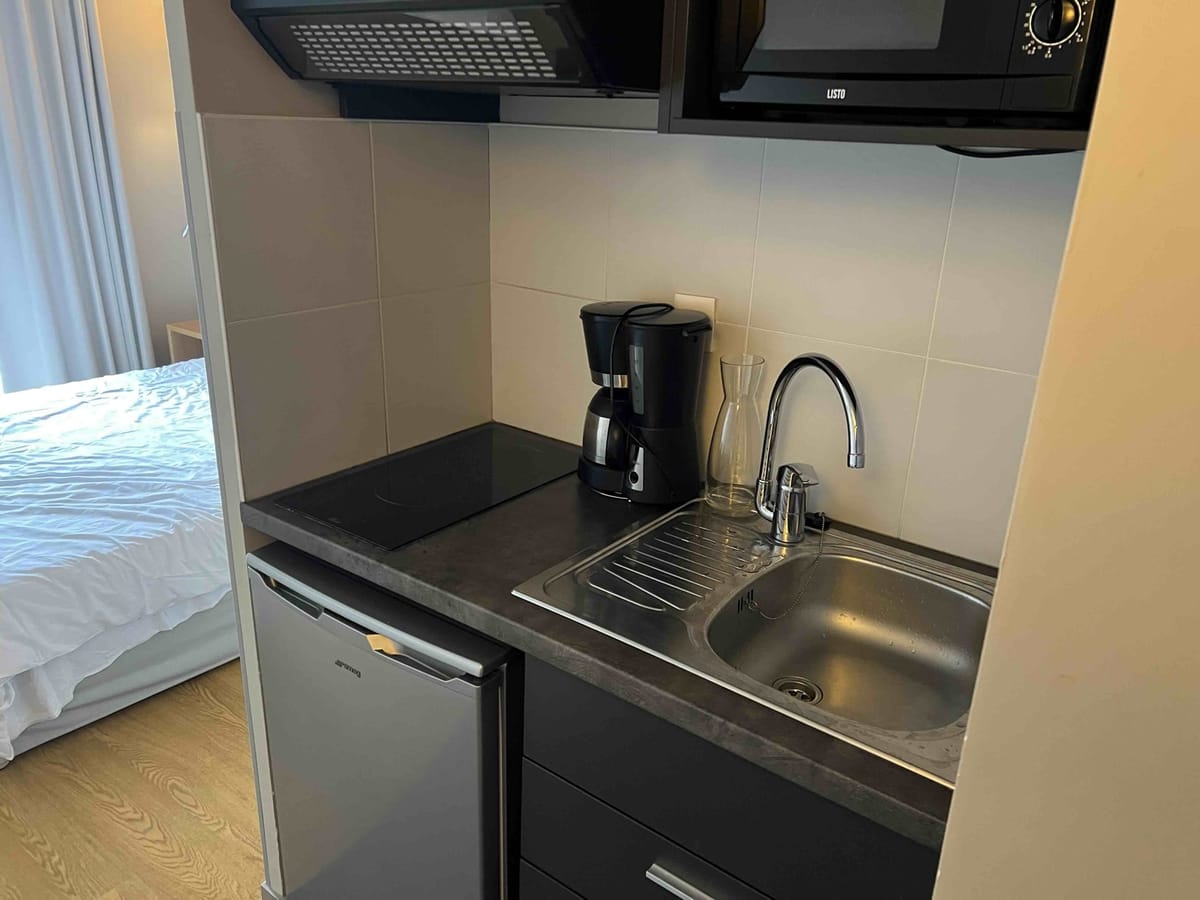
A hotel kitchenette isn't a kitchen. Usually it's two burners, a microwave, a small fridge that mostly works, and whatever pans the last guest left behind. Sometimes there's a kettle. Rarely an oven. The cutting board is the size of a postcard. The knife is whatever survived the last year of short-stay guests.
The meals that actually work in one of these don't ask for equipment you don't have, ingredients you can't find at the corner shop at 9pm, or techniques that need forty minutes of attention when you're tired from travelling.
Why cook in a hotel in the first place
Before I moved to Hamburg I used to fly in for stints at a time, and eating out for every meal wasn't feasible. Not financially, not in terms of how many cafeteria meals a human can take. I ended up booking apart-hotels because at least then breakfast and dinner could be simple and cheap.
Now when I travel it's mostly because a local supermarket tells you more about where you are than the tourist office. In Chamonix we found a spicy tuna dip at the Super U, next to the cheeses, a small brand with a reddish label. It became the second reason we go back. (The first is obviously Mont Blanc.) In Lefkada we bought whatever the fishermen had pulled in that morning, pan-fried it on the apartment's two-burner hob with lemon and olive oil. I went back the next day for more and they didn't have it. That's fishing.
So: cost, yes. Flexibility, yes. But mostly it's fun, and an hour in a foreign supermarket is free entertainment.
What to buy before you check in
Walk to the nearest supermarket (Aldi, Lidl, Rewe in Germany; Carrefour, Lidl, or a small Casino in France; Lidl, Conad, or Coop in Italy; whatever the country has) and get:
- Short pasta (penne or fusilli; travels and cooks better than long; roughly €0.80–€1.20 a box at most discounters)
- A can of tomatoes (around €0.70–€1 almost everywhere)
- A can of tuna in olive oil (€1–€2 depending on country)
- Olive oil, the smallest bottle you can find
- Salted butter (more on this below)
- Eggs (around €2–€3 for six at most European supermarkets)
- A lemon
- A baguette or whatever bread looks good
- Salt. Bring it from home in a zip bag. Half the time the kitchenette has none, and buying a whole kilo for two days of cooking is a waste. If you forget, buy salted butter. Salted butter doubles as your salt.
That's a shop that'll feed two people for three nights for under €20 at any European discounter, and it covers every meal below.
Eggs with whatever you have
The most adaptable kitchenette meal, always. Two burners means you can fry an egg while something else heats on the other. Eggs with canned tomatoes and whatever cheese is around. Eggs on top of the microwave potato. Scrambled eggs on the baguette. The Greek version with olive oil and a tomato.
The constraint version: a can of tomatoes, an egg, a bit of cheese, bread. That's dinner.
Full recipe: Where it all begins: eggs, cheese and tomatoes
A baguette sandwich, when the pan looks sketchy
The meal you make when you've just arrived, it's 10pm, you haven't eaten since the airport, and the pan in the cupboard is something you don't want to touch yet. Baguette, butter, a couple of slices of ham, maybe a tomato if the shop had one. Two minutes. No pan, no burner, no washing up.
This is also breakfast for the next three days. A baguette keeps reasonably well for two days if you leave it in its paper bag, and butter + ham is universal.
Filled pasta with butter and salt
The single most underrated kitchenette dinner. A bag of tortellini or ravioli — any European supermarket sells them, usually in the fridge section near the cheese. Boil them for the two or three minutes the packet says, drain, return to the pan off the heat, add a generous knob of butter and a pinch of salt. That's it.
Why it works: the pasta is already stuffed, so you've already got your protein and flavour. All you need to do is not overcook it. And butter-on-hot-pasta is one of those things that tastes complicated and isn't.
If the kitchenette has parmesan left from a previous guest, don't use it. Buy your own tiny wedge and grate it over.
Microwave potato
Underrated as a proper meal rather than a side. A medium potato, poked all over with a fork, microwaved for 5 minutes on one side, flipped, then another 4–5. It comes out fluffy inside with a skin you can actually eat. Top it with butter, a fried egg from the burner, a spoon of the can of tomatoes from last night, whatever's open.
The fork step matters. Skip it and the potato can explode — I've never had it happen but I've heard enough microwave-stained stories to take the warning seriously. Everything else is just time.
Full recipe: How to microwave a potato
One-pan pasta, with or without tuna
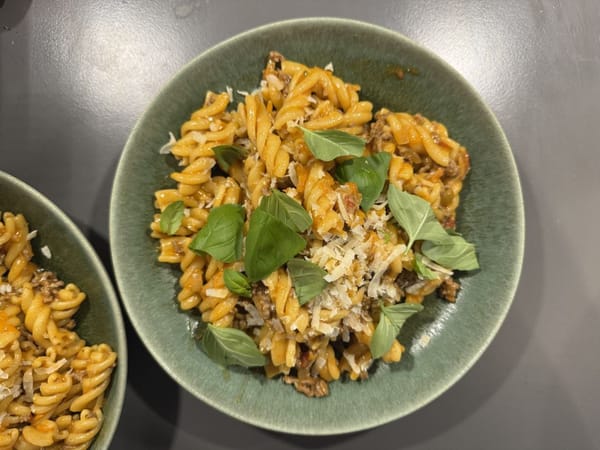
One pot, one burner, 15 minutes, barely any washing up. Everything goes in the pan together — pasta, water, canned tomatoes, garlic, olive oil, salt — and the starch released from the pasta as it cooks thickens the liquid into a sauce. Stir it a few times so nothing sticks to the bottom.
With a can of tuna drained in at the end, this becomes the single most reliable kitchenette dinner I know. The ingredients travel well, none of them need refrigerating before you open them, and the technique is hard to mess up.
Two recipes, one technique: - One-pan pasta for a kitchenette - Tuna tomato pasta with canned goods
Thin chicken or turkey, pan-fried
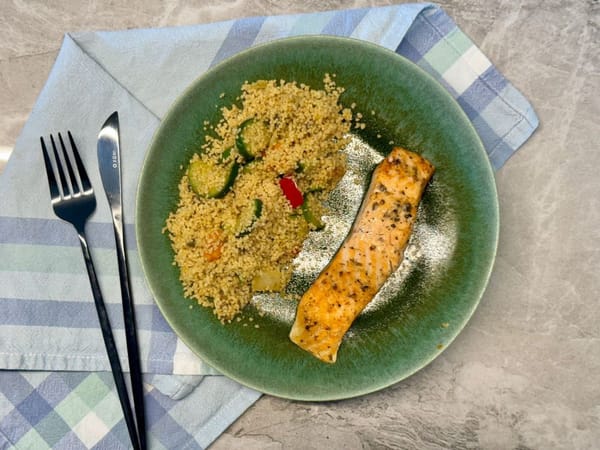
Lean meats are the easiest things to cook on a weak hotel burner because they forgive you. A thin chicken breast (a cotoletta-style cut, pounded flat if it isn't already) or a turkey cutlet cooks in four or five minutes total, and the temperature isn't critical. Medium-high is fine, medium is fine, too-low just takes longer. Oil the pan, salt the meat, cook until it looks cooked, squeeze lemon over it.
Pork I'd skip unless it's clearly a thin, tender cut. On a weak burner a thicker pork cut goes tough, and tough pork in a hotel room is a sad meal.
Pair it with the microwave potato, or a baguette, or just eat it off the pan standing at the counter, which is probably what you'll actually do.
What breaks in practice
The main failure mode isn't the technique — it's the shopping.
You buy the wrong version of a thing. In France I once grabbed something labelled crème that I thought was cream, and at home I opened it and it was tart and yogurty and nothing like what I wanted. French dairy is a rabbit hole — crème liquide, crème fraîche épaisse, crème entière, crème fleurette are all different things, and in a kitchenette with no English on the labels you will sometimes get it wrong. Make peace with it. Make peace with the other thing too.
You forget the seasoning or the fat. Pasta with nothing but sauce is sad. Fried eggs with no salt are sad. The easiest prevention: buy salted butter, which handles both.
You buy something you can't actually cut. With the postcard-sized cutting board and the survivor knife, a whole butternut squash is a bad idea. A watermelon is a bad idea. A chicken thigh on the bone is an awkward idea. Stick to what you can deal with using a weak blade and not much room.
You buy a steak. Don't. The pan isn't hot enough, the cut is probably wrong for what the pan can do, and you'll end up with grey meat. Save steak for when you have a real burner.
The pan is nastier than it looks. Wash it twice. They nasty.
Do you actually need an oven?
No. Two burners and a microwave cover almost everything. Roasting vegetables becomes pan-frying them; baking potatoes becomes microwaving them; baked pasta becomes one-pan pasta. Every meal on this list is oven-free by default.
If you want more variety without an oven, I wrote a sibling guide: 5 dinners you can make with no oven.
What if the fridge barely works?
A lot of kitchenette fridges are more like cool boxes. If yours is one of them:
- Eggs are fine at room temperature for a day or two. European eggs aren't washed the way US ones are, so they keep their natural protective layer and don't need urgent refrigeration. Use them first anyway.
- Ham, butter, and cheese are the first things to eat. Day one is ham sandwiches. Day two is eggs and cheese. By day three assume the ham is gone.
- Stick to shelf-stable after that. Canned tomatoes, canned tuna, pasta, olive oil, hard cheese in a dry corner, a baguette. These don't care about the fridge.
- Don't buy anything you wouldn't eat at room temperature if the fridge dies in the middle of the night, which it will.
What actually helps in a kitchenette
Wash the pan twice. See above. They nasty, and the person before you probably didn't.
Bring salt from home. A zip bag is all you need. If you forget, buy salted butter and use it for both jobs.
Get the pan hot before adding anything. Kitchenette burners are weak. Preheat longer than you think — a full two minutes of medium-high before anything touches it.
Cook forgiving things at forgiving temperatures. Thin meats, eggs, filled pasta. Not a steak. Not a whole roast. Save the hard techniques for when you're home.
One heavy pan beats three thin ones. If the kitchenette has options, pick the heaviest — it holds heat better and cooks more evenly on a weak burner.
A lemon fixes most things. A squeeze on underseasoned food, a fried egg, a pan of pasta, a piece of chicken — it sharpens everything and costs a euro.
Pasta water is your sauce thickener. A splash of the starchy cooking water stirred into whatever sauce you have thickens it and helps it coat the pasta. Doesn't cost anything.
Salted butter doubles as salt. If you forget salt, this is the move.
The wrap
A hotel kitchenette isn't a kitchen, and trying to cook as if it were is how you end up frustrated on a trip that was supposed to be fun. The move is to meet it where it is: two burners, a microwave, a sketchy pan, and a corner shop. Shop small. Wash twice. Cook forgiving things. Eat well anyway.